Tuesday, 25 March 2014

Miracles? Why not? (revised 25 March 2014)

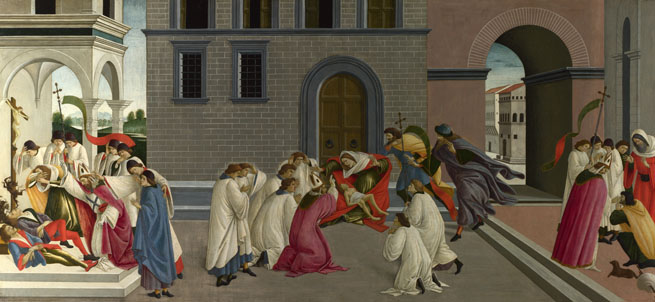
Three miracles of St Zenobius
Recently a friend directed me to a BBC web article  by Prof Jacalyn Duffin, who had investigated 1400 miracles documented by the church over 400 years. She was impressed by the thoroughness of the evidence gathering and the rigorous assessments of the tribunals. She recently published this book:

Medical Miracles: Doctors, Saints and Healing in the Modern World.

Initially I was surprised to find a strong case for the reality of miracles being provided by an atheist. Her particular faith is philosophical materialism, the main form of atheism of which I'm aware.

 But should I be surprised?  She believes that all phenomena are governed by natural laws and that miracles will one day be explained by yet to be discovered natural laws. There is no reality outside the realm of science. So this exclusively naturalistic reality must have created itself, existed before it existed.  In this scenario anything could happen because the scenario is intrinsically irrational. A fried egg could appear in front of a group of atheists at any time without an eyebrow being raised. In fact there would be a lot of surprise and denial; but the surprise would be entirely illogical  since in a reality where a universe creates itself before it exists and all phenomena are meaningless chance events, anything can happen at any time.
 
Atheists in effect share this view with pagans, who believe in multiple gods who compete with each other but who do not operate within a rational system. Within the Christian worldview miracles would be expected to occur less frequently and only when they serve some purpose. For example, Jesus cured a blind man to teach that the spiritually blind can be made spiritually aware by faith.

God would work through natural laws known and as yet unknown, leaving open the possibility of laws that exist outside the realm of logical investigation. In fact the medical miracles performed by Christ were all based on accelerating or reversing entirely natural processes, rather than bizarre ones such as causing a human limb to regrow. Restoring sight, for instance, meant reversing the process which led to blindness and this is repeatedly recorded in the New Testament; whereas limb regrowth would require a mechanism that exists only in certain reptiles and amphibians. No miracles of this nature are recorded in the manuscripts of the New Testament.

What about the non-medical miracles of Jesus, such as walking on water or calming the storm? This is where anyone up to date with physics and mathematics is in a better position to see how such things could happen than a 19th century scientist, providing we make the assumption that the universe was created not by itself before it existed but by an all powerful rational Creator.

Superstring theory, for instance, which looks like having a good chance of integrating the 4 forces of nature (electromagnetism, gravity, strong nuclear and weak nuclear) , invokes 10 dimensions – 9 of space, 1 of time. This compares with our 3 space dimensions (length, breadth and depth) plus 1 of time (along which cause and effect proceed).  God would be able to use any number of dimensions to perform a miracle. It can be shown mathematically that a basketball can be turned inside out without tearing it by transferring it temporarily into 5 dimensions (4 of space, 1 of time). 

In cosmology there is a theory which appears in the mainstream academic literature that our ‘reality’ is simply an illusory manifestation of a 2 dimensional hologram.  What else could happen in such a reality I would not like to guess.


https://www2.ucar.edu/sites/default/files/news/2010/redsea_a_UCAR-final.jpgThe parting of the Red Sea has been 'explained' as due to a 63 mph easterly wind creating a dry corridor or as a tsunami where the water recedes prior to the arrival of the wave. These interpretations do not even need to invoke the latest concepts in physics. The miracle is in the timing. Had  it not happened history would have been very different, or, more likely in my view, there would be nothingness - no past, no present, no future, no universe, no human beings - because such an event was in God's mind before the universe was brought into being, an essential part of the whole of creation, a creation that would be meaningless without it.

  Since the Enlightenment, up to the beginning of the 20th century, there had been an increasingly reductionist, left-brain centered view of our world which had made miraculous phenomena seem increasingly improbable . Now it is accepted that things are immeasurably stranger than was imagined at, say, the time of Darwin, when most people thought that a cell was no more complex than a blob of jelly and that the universe was just a great clockwork machine. 

Our worldview has progressed a lot since then. The philosophy of David Hume (the no.1 anti-miracle man)  has also been superseded and Goedel’s Incompleteness Theorem, together with Heisenberg’s uncertainty principle, show indisputably that there are built-in limits to what can be investigated scientifically or even logically.

 Now we accept, as standard, miraculous quantum events, such as the experimentally proven instantaneous propagation of a signal independent of distance (quantum entanglement), the Big Bang and cosmic fine tuning for the genesis  of self-conscious beings. And time reversal is a common concept used  in discussing elementary particles  and the concept of a multidimensional reality is part of the currency of theoretical physics.

The Incarnation and the Resurrection are entirely plausible, albeit beyond our power to visualize, given the physics and the  evidence written down in Koine Greek within a few decades of the events and 300 years before the Roman church was established. The numerous witnesses to the post-Resurrection appearances of Jesus presented human beings with an awareness of a totally new state of being - neither purely physical nor purely spiritual, both solid to the touch and able to appear instantaneously in an empty room.

History from ancient man up to about 100 years ago  can be viewed as a progression (via the Enlightenment) from a pre-rational age to a rational one. Now we are moving into a trans-rational age in which reason will be a powerful servant but not the master.


See also
The doctrine of chance (Psalm 151 for atheists)


Friday, 14 February 2014

Saving democracy (substantially updated 26 Feb 2014)


In my country (UK), at least, there appears to be a tranche of influential people hell bent on stripping Christianity from mainstream society, thereby removing the general encouragement and inspiration that we flawed human beings need if we are to adhere to the values of Christ.

What used to be called Christendom is now called the West and most of it is at least nominally run on democratic principles with elections and parliaments or congresses or  similar institutions. The West is where the rest want to go or what they seek to emulate and it is where the aid and charity flows from, not to, and where the people load themselves with guilt for the sins of their ancestors.

Secular Terrorism: the slow suicide of Christian Britain
If one had to summarise the right hand column in the table below one could say that democracy can only function if the imago dei (the image of God) is sanctified in man and woman through Jesus Christ: truth, justice, love (including love of one’s enemy), charity, patience, humility, self control, creativity, recognition that all are equal before God (no two people are equal in any other way, hence the move to abolish slavery, racism and the exploitation of the female gender is all based on Christ's revolutionary paradigm changing teaching), forgiveness and mercy.

No human being exhibits all or even most of these qualities, and certainly not all the time. But they are there as ideals, buried deep down in the being of most people living in a Christian culture.

 see also Europe's Civil War: the separation of church and state itself has Christian roots, which appears in the February 2014 issue of Prospect magazine, p.46-48. This shows how the idea of individual conscience and liberty grew from the New Testament.

REQUIREMENT FOR DEMOCRACY
DEPENDENCE ON CHRISTIAN VALUES

Electorate with a clear understanding of the present situation, its historical background and wider context. People have to face reality and this must be based on belief in truth.

Belief in God is needed for truth to be conceptually possible and the entry of God into humanity through Christ makes it meaningful to humans.

Right of free speech tempered by the need to restrain evil (especially in the media).

What is evil? This is not a man-made concept and we recognise it by its hostility to the values and presence of  Christ. We need to have legislation but it can't do the whole job. A moral consensus is needed on which to base a common moral sense that can't be written down.

Presentation of proposed policies to the electorate through the media without distortion.

Subjugation of pride and ego so that balance and truth can at least be sought and recognised. Pride is the number one sin for Christianity.

Selection of morally righteous and rational policies by the electorate and by parliament or congress.

Concern for the poor, the weak and the sick regardless of class, race, nationality, religion or history are exclusively Christian precepts.  The Nazis actively opposed them due largely to Nietzsche. Rationality springs from devotion to truth – also made sacred by God's incarnation through Christ.

Enactment of the bills passed by parliament or congress. This involves public institutions, emergency services, armed forces, the civil service and the machinery of government. Thousands of decisions, all subject to human frailty, are taken in diverse situations both numerous and complex.

A general consciousness that we are made in the image of God as revealed in us by Christ. Take this away and the scope for distortion and evil must necessarily multiply.

Optimism that the toughest and most intractable seeming problems can be solved and that the darkest episodes of human history can be overcome.

Faith in the creativity of man (one aspect of the image of God) and in the triumph of life over death as evidenced in the Resurrection.

A sense of fair play, justice and mercy.

All three must be held sacred. A loving Creator who entered into human history makes this possible.


  I invite you to consider the consequences of de-sanctifying these values. How long would democracy last? 

The concept of democracy originated with Plato. He himself thought it was flawed because of human nature in that it depended on people voting wisely. In fact, as he well knew, they would mostly vote for policies which reduced their taxes or gave them more free government services or sacrificed wise long term policies to those giving immediate gratification or ignored the underdog or killed off, probably initially in the nicest humanistic way, those too expensive to look after (handicapped infants or the elderly infirm, for instance), or waged war at the exhortation of a demagogue who had appointed himself or herself to fill in the spiritual vacuum and declare war to get resources from another country, or for policies which allowed the nation to become so weak that it was unable to fend off attacks by other nations or prevent terrorism within its borders. Bad decisions would lead to social and financial breakdown and chaos followed by authoritarian, thought controlling government.

So to those who advocate airbrushing Christ out of our culture and society I say think again and think hard and think straight - for God's sake and for ours.

See also
Secularism is dangerous, especially for secularists

 John Sears


Sunday, 9 February 2014

Blindsight, animal pain and suffering (updated 22 Feb 2014)


People without a visual cortex seem to be blind yet it appears some respond to optical information from the world around them. This phenomenon is known as blindsight. The Oxford English dictionary defines it as ‘the ability to respond to visual stimuli without consciously perceiving them, a condition which can occur after certain types of brain damage.’

 My understanding as a layman is that optical signals from the outside world, having been converted into neural signals by the retina, are relayed not only to the visual cortex but to other neurological centres which somehow allow the person, or animal, to take survival action – for example, avoiding crashing into a table even though they can’t touch it or consciously see the table or a picture on the wall. See this video.


In his book Nature Red in Tooth and Claw (I’ve not yet read it but hope to do so) the philosopher Michael Murray, who analysed a large amount of scientific literature, describes this phenomenon in relation to the experiencing of suffering as a consequence of injury. It seems that in humans and primates pain stimuli are transmitted to various neurological functions, one of which is related to our sense of self. When sensing pain through injury we experience self-pity,  anger at our own stupidity or someone else's for letting it happen, or anger at God. We also soon think of the implications for our family and our own lives. We also anticipate pain with dread if it looks like we are at risk of injury from, say, an approaching lion. (Pain can also result from certain diseases and this is another question. I'm not sure whether the book deals with this.)

Below the level of the primates, mammals such as rabbits, deer and dogs may not, according to Murray, feel pain in a self-conscious way. Such creatures don’t have the neurological channels associated with self-conscious pain awareness present in us and other primates. What they experience is analogous to blindsight. There is a neurological reaction at a certain level. It makes a dog yelp, for instance and the animal's body senses damage in some way, causing it to behave in a way which we perceive as distress. Maybe it’s to warn other dogs to steer clear of whatever caused the injury. But there is no self-pity or anxiety about the injury and its implications.  The dog is in a state it instinctively wants to escape from, and a message to avoid any  situation which might lead to this state is somehow lodged deep into its neurological system (e.g. steer clear of men with guns) to govern future behaviour

Recently I learnt of reports from lobotomy patients decades ago (before the treatment became controversial) that when their prefrontal cortex was removed they often felt pain but somehow it did not bother them in any way. A clear distinction between pain and suffering.

The structure and functioning of the brain is barely understood. For instance, neurologists do not agree on the demarcation of a given zone from those surrounding it, including the prefrontal cortex. Moreover, the human prefrontal cortex, which is associated with self awareness and hence perception of suffering, is 'absolutely, obviously and tremendously different' from that of any other creature, according to J.K.Rilling , a specialist in neuroimaging. (Trends in Cognitive Science, vol.18 no.1, January 2014.)

At the lowest level of the animal kingdom – insects, worms, snails etc.–the difference is obvious to anyone. The evidence seems to indicate a single neural pathway. Possibly there is no pain at all when, say, a fly is swatted. It may take evasive action, but so would a robot programmed to move out of danger when hit by a bullet. The single neural pathway is simply to help it survive.

 The idea that the natural world is cruel  might be a result of arrogantly projecting the nature of our own being onto the animal kingdom in general, especially onto those animals  (pets etc.) which seem closest to us. To prove this, of course, is philosophically impossible. We can only say what is the most likely situation on the evidence available and that the evidence is beginning to point in the direction of a fundamental difference between homo sapiens and any other species.

Some may worry that that this could be used  to justify bad treatment of animals but I don't see it that way.  We can never prove what animals feel like: as I said in a previous post  certain aspects of reality cannot be reached by logic. Moreover, gratuitously harming a living being, a manifestation of life, is dehumanising and evil, regardless of whether it feels pain or suffers in a self-conscious way.


John
cosmik.jo@gmail.com

Author, 2077: Knights of Peace